How iiTzTimmy climbs Valorant's lowest to highest rank challenge in 2026
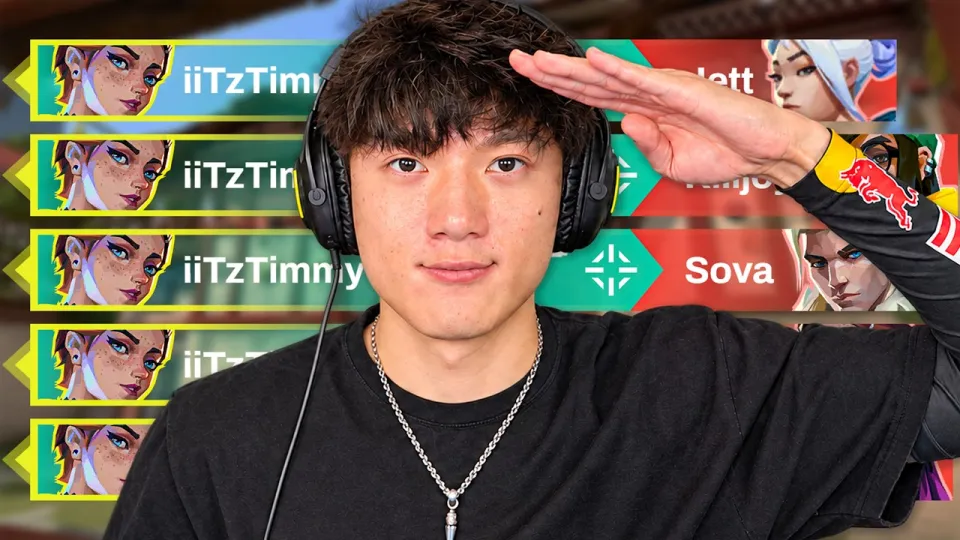
Video: I Might Be Getting TOO Good at Valorant… (Lowest To Highest Rank Challenge)
Need articles like this for your video? They help promote it on YouTube and Google — order them in the Telegram bot @sat_sit_bot. The bot writes and publishes the articles itself (with your YouTube video embedded) on popular topical websites (no ads). Try it free: 50 articles on us.
· based on the channel iiTzTimmy Two
Valorant's lowest to highest rank challenge is a self-imposed climb where a player starts in the bottom tiers of ranked and grinds upward toward Radiant without stopping, and iiTzTimmy's version of it is built on reading lobbies rather than raw aim. The run is streamed live on Twitch, where the full session, chat reactions and the unedited losses are available, while the condensed version lands on the iiTzTimmy Two channel. The point of the format is simple: the rank ladder is long, and the interesting part is how a high-level player adapts to teammates and opponents who do not think like him.
What the lowest to highest rank challenge actually tests in Valorant
The climb from Iron-tier lobbies to Radiant is less about mechanical skill and more about translating a top-level read into calls that lower-ranked teammates can follow. In a normal Radiant game, everyone already knows the default timings, the trade patterns and when to give up a site. In the bottom tiers, that shared language is missing, so a player who plays "correctly" for high elo can look useless — he entries alone, dies to a stack, and the round is gone.
iiTzTimmy's approach in the run leans on three habits:
- Take the first duel only when the trade is already set up behind you, not because you are the best aimer in the lobby.
- Convert individual advantages into map pressure instead of chasing a second and third kill.
- Keep comms short and repeatable, because a long explanation mid-round is noise in a lobby that is already reacting late.
The challenge also exposes a ranking truth: the fastest way up is not a highlight reel of aces, it is a low death count and a high impact-per-round. A player who goes 30/4 in Ascendant, as one viewer described from their own games, is doing the same thing on a smaller scale — winning the rounds that matter and not feeding the ones that are already lost.
Reading the lobby is the real skill gap
The most instructive sequence in the run is not a clutch but a bad teammate: the Cypher in the first game who blamed his team for everything. He pushed first into site and then complained, nitpicked his teammates' decisions and, most damaging, invented comms that were never given — the infamous "A cage" call that existed only in his head. That is the clearest illustration of how mental state, not aim, decides low-rank games.
A Cypher who plays for information has enormous value in Valorant: trips on flanks, a cage that denies a sightline, a camera that spots the rotate. A Cypher who treats the kit as an entry tool and then looks for someone to blame is a net negative, because the team spends the round reacting to arguments instead of to the map. The viewer reaction to that player was blunt, and it was right: if a game is producing that much tilt over comms, a break does more for the rank than another queue.
By contrast, the Reyna in those lobbies came across as the sensible one — the player who simply played her role, took the duels she could win and did not narrate every mistake. In a mode where five strangers share one voice channel, the calm player is usually the one who ends up with the higher ACS.
Why the second lobby behaved so differently
The second game flipped the dynamic completely: opponents were desperate to make a play on a well-known streamer, and many of them had no idea who was actually in the lobby. That produces a specific kind of chaos — over-peeking, early aggression, and a willingness to trade a full buy for a highlight. Playing against that is a different test than playing against disciplined Radiant opponents, and it rewards patience over flash.
A few practical adjustments for anyone facing the same situation in their own ranked games:
- Let the aggressive team come to you; hold an off-angle and take the free first kill instead of matching their pace.
- Track ultimate economy — the run included a moment where a viewer questioned whether the ultimate should still have been active after a kill on Clove, which is exactly the kind of detail that decides a retake.
- Use utility to slow the push, not to win the aim duel; a cage or a smoke buys the two seconds a rotator needs.
The fake AFK moment that got clipped is the same idea in social form: a lobby that is watching for a reaction will give away information if you let it.
Settings, frame rate and the small things viewers ask about
Mechanical questions dominated the comments, and they are worth answering honestly. Sensitivity and DPI are personal, and copying a pro's number without matching grip, mousepad space and monitor size rarely transfers — the useful approach is to pick an eDPI range that lets you do a full 180 with a comfortable swipe, then leave it alone for a month. Viewers also noticed the smooth, very high frame rate on stream, which is a production advantage rather than a gameplay secret; a stable 144 Hz setup with consistent frame times beats a fluctuating 300 fps in terms of how the game feels.
The flick that got clipped late in the run, where only a sliver of a target was visible, is the result of crosshair placement and pre-aiming common angles, not a lucky twitch. That is reproducible: walk the map in a custom game, place the crosshair at head height on every common hold, and the "impossible" flicks shrink into normal shots.
How to run your own lowest to highest rank climb
Anyone can copy the format without streaming it. The structure that makes it work:
- Start a fresh account or use your lowest-ranked one, and commit to a fixed number of games per session so tilt does not stack.
- Review one lost round per session and name the actual mistake — a bad peek, a missed trade, a utility dump — instead of blaming the lobby.
- Mute the player who invents comms; keep the one who gives short, accurate information.
- Track impact per round rather than kills, and stop queueing after two straight losses.
- Play one agent long enough that the utility becomes automatic, then expand.
The climb is a marathon of small decisions, and the players who move up fastest are the ones who stop treating every round as a personal duel.
Useful links
- Live stream and full sessions: https://www.twitch.tv/iiTzTimmy
- Updates between streams: https://twitter.com/iiTzTimmy
- Clips and behind-the-scenes: https://www.instagram.com/iiTzTimmy/
- Short-form highlights: https://www.tiktok.com/@iiTzTimmy
- Community and queue partners: https://discord.gg/iitztimmy
Final takeaway on the Valorant rank climb
The lowest to highest rank challenge works as content because it strips Valorant down to the parts that actually decide ranked games: patience, comms discipline and the ability to read who you are playing with. iiTzTimmy's run shows that the loudest player in the lobby is usually the one losing it, and that a calm Reyna outperforms a tilted Cypher every time. If you want to follow the climb as it happens, watch live at twitch.tv/iiTzTimmy, and catch the edited runs on the iiTzTimmy Two channel, which produced this breakdown.
Key takeaways
- The challenge format: start from the bottom of Valorant ranked and climb toward Radiant in one continuous run.
- iiTzTimmy streams the full grind live at twitch.tv/iiTzTimmy and posts condensed runs on the iiTzTimmy Two channel.
- The first lobby's Cypher became the case study in bad mental: blaming teammates, nitpicking calls and inventing comms.
- A Reyna in the same games was the calm, sensible voice — the opposite of tilt-driven decision making.
- Viewers flagged a possible ultimate bug after a Clove kill and asked about sens and DPI settings.
Questions & answers
What is the lowest to highest rank challenge in Valorant?
It is a self-imposed climb where a player starts in the bottom tiers of ranked and grinds upward toward Radiant in one continuous run. The format is popular because it shows how a high-level player adapts to lobbies that do not share his habits. iiTzTimmy's version is streamed live and then cut down for YouTube.
Why did the Cypher in the first game get so much criticism?
He entered site first and then blamed his team, nitpicked their decisions and called out utility that was never used — the invented "A cage" call being the clearest example. That combination of bad positioning and bad mental turns a strong information agent into a liability. Viewers pointed out that a break from the game would help more than another queue.
Was there a bug with the ultimate after killing Clove?
A viewer flagged the moment where the ultimate appeared to stay active after a kill on Clove, which is the kind of interaction that decides a retake. Valorant has had ultimate-refund quirks around Clove's kit before, so it is worth checking the current patch notes rather than assuming. Treat it as an observation from the run, not a confirmed bug.
What sensitivity and DPI does iiTzTimmy use?
He has not published a fixed number in this run, and copying a pro's exact sens rarely transfers because grip, mousepad space and monitor size all matter. The practical method is to pick an eDPI that allows a comfortable 180-degree swipe, then keep it unchanged for at least a month. Consistent frame times matter more for feel than a very high peak frame rate.
Source: I Might Be Getting TOO Good at Valorant… (Lowest To Highest Rank Challenge) · Markdown version